

Horizontal feed dryer
- 3 models in the specification table
- Downloadable catalogue
- Product video
- Technical advice & support
• Stable and reliable air inlet: Equipped with a high-precision humidity sensor for accurate control of air humidity in the horizontal dryer.
• Fully enclosed spreader: The spreader is driven by a servo system that continuously varies motor speed, so material is distributed evenly.
• Negative-pressure dehumidification: Negative-pressure dehumidification technology effectively reduces unpleasant raw material odours.
• Sound structure: A fully sealed structure ensures hygiene, and professional insulation design reduces energy loss.
• Temperature zone settings: Reverse cross-flow drying technology is used, and drying takes place in several controlled temperature zones, making drying more uniform and reducing energy consumption.
• High efficiency and energy saving: Steam consumption per ton of finished product: 170–210 kg; gas consumption per ton of finished product: 11.5–15 m3
• Intelligent control system: One-click start-up, monitoring of moisture and energy consumption, fault search, production data queries and other functions
• Environmental protection: Full compliance with European and American environmental standards
• Moisture uniformity controlled within ±0.5%
• Single-cycle fan system with low energy consumption
Horizontal feed dryer specifications
Horizontal dryer technical specifications
| Model | Production capacity (t/h) | Drying area (m²) | Belt width (m) | Power (kW) | Moisture (%) |
|---|---|---|---|---|---|
| SHGW 120×2 | 1.5-2.5 | 20 | 1.2 | 28 | 15% |
| SHGW 180×2 | 3-4 | 30 | 1.8 | 36 | 15% |
| SHGW 240×2 | 4-5 | 2.4 | 48 | 15% |
Unique Technology and Design of the Zhengchang Horizontal Dryer
Applications of the Horizontal Dryer
In aquatic feed production, materials coming from the extruders or pellet mill enter the horizontal dryer. Besides working well and producing high-quality feed, the horizontal dryer is easy to control and has low energy consumption.
This machine effectively solves the problems of drying bulky aquatic feed and feed kernels. Horizontal dryers are used in aquatic feed mills to remove excess moisture, dry the feed and improve its appearance.
The main body of the horizontal dryer consists of six parts: spreader, feeder, heat exchanger, middle section, return section and discharge door.
How the Horizontal Dryer Works
During drying, hot air passes through the feed and removes its moisture. Part of this airflow leaves the machine, while the rest is reheated by the heat exchanger and returned to the dryer together with fresh air, giving optimal energy use. The horizontal dryer has two or three layers of conveyor belts; after moving along the first belt, material drops onto the second and third, and its moisture is reduced over a set time.
Advantages of the Professional Horizontal Dryer
The dryer feeder is driven by a chain-linked rod, and its discharge section moves back and forth. The feeder’s sliding chute inlet is positioned so that material is spread evenly. The feeder is made of durable steel with glass wool insulation to retain heat. The dryer is also equipped with a circulating fan with a frequency converter and pressure and humidity sensors.
The middle section of the dryer is divided into three zones: high (130 ℃), medium (115 ℃) and low (100 ℃) temperature. Each zone works with its own fully independent air circulation system. Air inlets and outlets between sections make airflow easy for the operator to control, and each section has a precise time and temperature control system.

Materials pass through the three temperature zones in turn and moisture uniformity is controlled within ±0.5%. In the high-temperature zone, where the airflow is hotter, surface water on the cool, moist incoming feed evaporates quickly, improving dryer efficiency.
As materials dry, surface moisture gradually disappears in the high-temperature section, and too much heat lowers material quality. The medium-temperature section ensures dryer efficiency and high material quality. The lower temperature uses less energy, completes the drying process and lowers material temperature, preparing it for the next stage, cooling.
Horizontal feed dryer video

Shrimp feed pellet mill
The shrimp feed pellet mill produces high-quality aquatic feed (shrimp feed). The machine uses a belt conveyo…

Aquatic feed extruder
The aquatic feed extruder is highly adaptable for precise processing of diverse formulas with low starch and…

Pulverizer
The pulverizer includes a speed-regulating system, a grinding system with cutting blades and a built-in class…
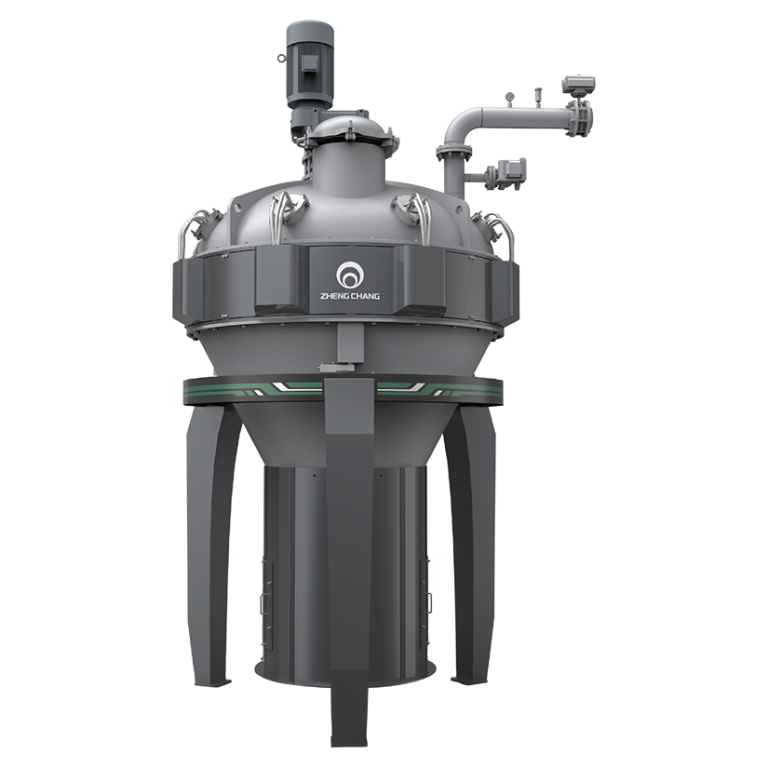
Vertical vacuum sprayer
Vertical vacuum sprayer with uniform spraying at short intervals for the best feed quality Eight-ring nozzle…